
Why Users Hate Losing Things They Never Bought
Ownership doesn't start at checkout. Your brain claims something the moment it lands in your cart, trial account, or workspace, and losing it already hurts.

A Cornell Mug That Ruined an Assumption in Economics
In 1990, Daniel Kahneman, Jack Knetsch, and Richard Thaler gave half a group of Cornell students a coffee mug - the kind that sold at the campus store for six dollars. Owners were asked the least they’d sell it for. Non-owners were asked the most they’d pay for one. A mug should be worth the same either way but it wasn’t. Owners wanted $5.25 on average. Non-owners offered $2.25 to $2.75. Ten minutes of holding a mug had roughly doubled its price in the owner’s head.
Thaler had already named this pattern the endowment effect a decade earlier, after noticing people refuse to sell things for prices they’d happily have paid to buy the same item. The mug study is what turned his hunch into a number.
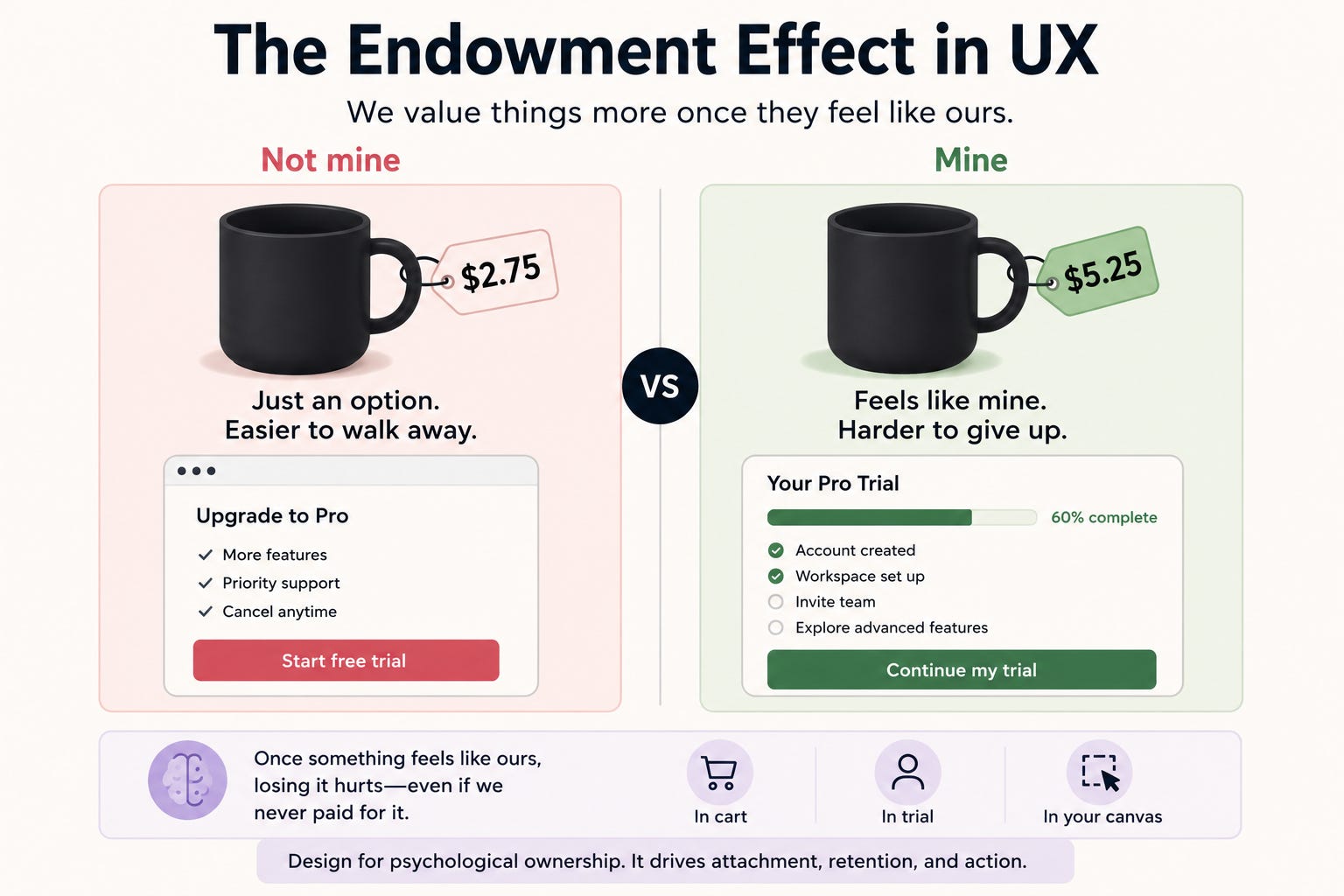
Then Duke Turned It Into a Fourteen-Times Gap
Duke's basketball tickets go to a lottery, after a week of students camping outside the stadium. In a study published in 2000, Dan Ariely and Ziv Carmon called both the lottery's winners and its losers. Losers said they'd pay $175 for a ticket. Winners wouldn't sell theirs for less than $2,400. Same ticket, same seat but the only thing that changed was which side of ownership someone stood on, and it moved the price fourteen times over.
Why a Swipe Persuades More Than Your Copy Does
Joann Peck and Suzanne Shu found people don’t need legal ownership to feel like something’s theirs - touching it, or picturing themselves touching it, is enough to raise what they think it’s worth. That’s the real mechanism behind a cart icon filling up, a wishlist heart turning solid red, dragging a player onto your Dream11 team. None of these are purchases. All of them are small installations of ownership.
SaaS teams use this on purpose now. Get a trial user to build three projects and invite two teammates in their first week, and cancelling stops feeling like declining a purchase, it feels like giving up three projects and two teammates.
The Honest Bit
This isn't as settled as it's usually presented. In 2005, Charles Plott and Kathryn Zeiler re-ran the mug experiment with tighter controls, and the buy-sell gap vanished, their argument was that subjects were misreading the experiment, not feeling loss aversion. Other researchers pushed back in 2011, saying Plott and Zeiler's own data still showed a gap in context. Plott and Zeiler wrote back defending their reading. That argument still isn't closed. The pattern shows up reliably in the field though - housing, tickets, trading cards but exactly why, and how easily wording alone can switch it on or off in a lab, is still contested by people who've built careers on the question.
Where Ownership Stops Working
John List studied traders at a sports card show and a pin market. Inexperienced traders held onto what they'd been given 72% of the time. Experienced traders held on only 48% of the time, close to what theory predicts with no endowment effect at all. Experience wears the bias down. Kahneman made a related point: the effect is strong for goods people hold to use, and weak for goods held to resell. A dealer flipping stock doesn't get attached to it the way a collector gets attached to a keepsake. Your newest users feel this the most. Your power users, and anyone reselling through your platform, will see through it.
Don't Confuse This With the IKEA Effect
People who assemble their own IKEA furniture value it 63% more than an identical pre-built piece - that's Norton, Mochon, and Ariely's finding, and it's a different lever. Effort creates that attachment. Nobody assembled the Cornell mug; it was handed over, and the price still doubled. A "design your own" flow runs on effort. A cart or a trial runs on mere possession. Know which one you're actually pulling.
Where This Turns Into a Trap
Amazon's Prime cancellation flow, internally called the "Iliad Flow," made a subscriber click through four pages and fifteen options, each one reminding them what they'd lose. The FTC filed a complaint over it. Reminding someone what they'd give up isn't automatically manipulative, it's the maze that crosses the line. The FTC's Click-to-Cancel rule, with provisions taking effect through 2026, exists to make this a compliance question now, not just a design-ethics one.
Give first-time users something small to build or save in session one. Write cancellation screens that state real losses honestly, on one screen, not five. Don’t waste ownership cues on power users who’ll see the trick immediately. And check whether a feature you’re crediting to the endowment effect is actually the IKEA effect wearing its clothes.
Where’s the line for you, between reminding someone what they’d lose and trapping them so they never get to leave? Comments are open.